


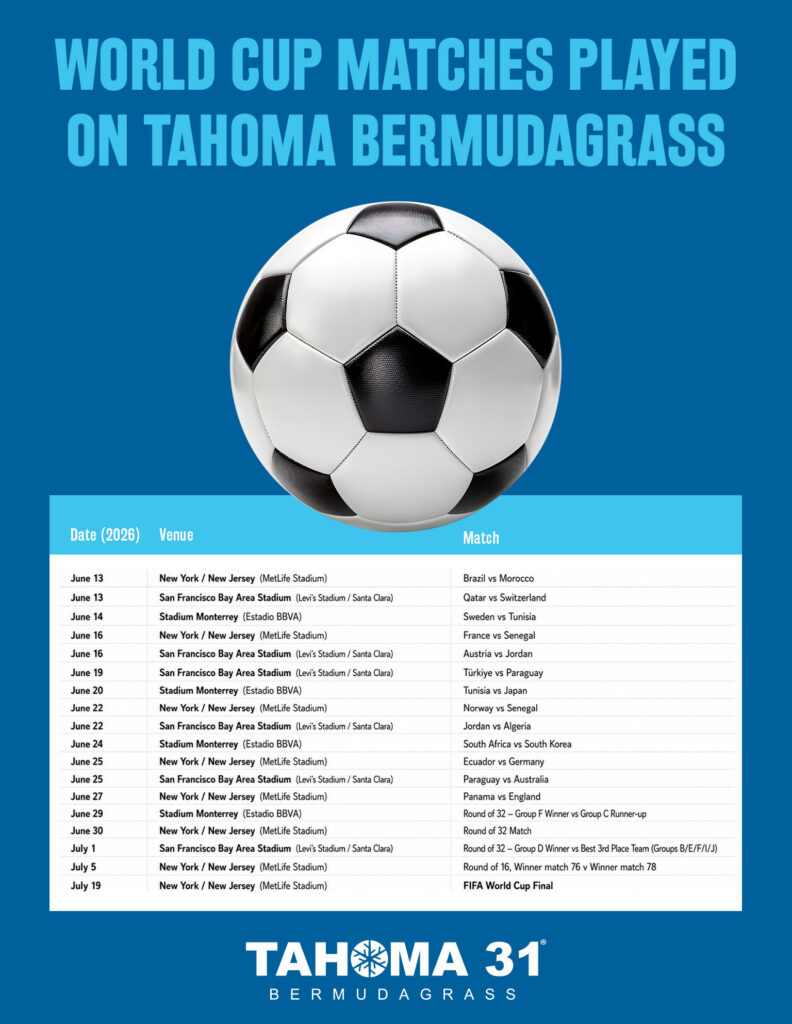
Nearly half of the stadiums planted with bermudagrass for the 2026 FIFA World Cup competition are grassed with a warm-season variety called Tahoma 31. The grass creates a resilient, sure-footed playing surface to promote player safety and hold up to the type of punishment indicative of futbol’s most agile and aggressive players.
Per FIFA rules, all 16 of the World Cup pitch surfaces are planted with natural grass. The competition spans stadiums in Canada, the United States and Mexico. Turfgrass sports field managers were given the option to plant warm-season bermudagrass or cool-season bluegrass overseeded with rye for the competition.
Eight stadiums chose varieties of bermudagrass as their playing surface. Nearly half chose Tahoma 31. They are: Stadium Monterrey (Estadio BVA) in Monterrey, Mexico, home of Rayados professional soccer; Levi’s Stadium in San Francisco, home of 49ers NFL football; and MetLife Stadium in New York/New Jersey, home of the NY Jets and Giants.
Sports field managers at the stadiums performed meticulous research to select the grass they felt would perform best for their location and climate, while also meeting FIFA’s strict guidelines for tournament prep. At Stadium Monterrey (Estadio BBVA) in Mexico, Carlos Castillo, manager of the pitch and natural areas, invested more than a year to research the right grass for his facility. Several factors went into his selection of Tahoma 31.
The 53,000-seat stadium has a curved roof overhang that throws shade on the pitch. Wear tolerance for professional-level play was a factor, as was cold tolerance. Tahoma 31 met his criteria. The pitch infrastructure was renovated and the grass was installed in July 2025, just shy of a year before the first World Cup match at Monterrey on June 14, 2026.
While fans may be focused on the goals scored on the pitch, Castillo says he has only one goal in mind:
“To have the best pitch in the World Cup.”
Tahoma 31 FAQs
What type of grass is it?
Tahoma 31 is a hybrid bermudagrass
Where was Tahoma 31 developed?
Oklahoma State University
What is the texture of Tahoma 31?
It is a fine-textured bermudagrass
What is the color of Tahoma 31?
Dark green
What stressors does Tahoma 31 tolerate?
- Cold. May be planted farther north than most commercially available bermudagrasses
- Wear. Especially sports-related wear
- Shade. More shade tolerant than most bermudagrass varieties
- Less water. Uses significantly less water than most bermudagrasses once established
- Drought. Stands up to and recovers from drought better than most commercially-available bermudagrasses
Where may Tahoma 31 Bermuda be used?
- Sports fields
- Golf
- Lawns